1.Introduction
Artificial Intelligence is quickly becoming a key part of modern products. From chatbots and recommendation engines to automated workflows, companies are using AI to improve efficiency and user experience.
However, while the adoption of AI is increasing rapidly, many organisations are not paying enough attention to one critical aspect — testing.
Unlike traditional software, AI systems do not always behave in a predictable way. This makes them powerful, but also risky. If not tested properly, AI features can lead to incorrect decisions, security issues, and even legal problems.
For technology leaders like CTOs, Product Managers, and QA teams, the challenge is not just building AI — it is ensuring that AI works safely and reliably in real-world scenarios.
2.Why AI Systems Are Different from Traditional Software
Traditional software works on predefined rules. If you give the same input, you will always get the same output.
AI systems are different.
They learn from data and make decisions based on patterns. Because of this:
- The same input can produce different outputs
- The system may behave differently over time
- Unexpected results can appear in real-world usage
This unpredictability is what makes AI useful — but it is also what makes it difficult to test.
3.Common Risks Associated with AI Features
When AI systems are not properly tested, several risks can arise.
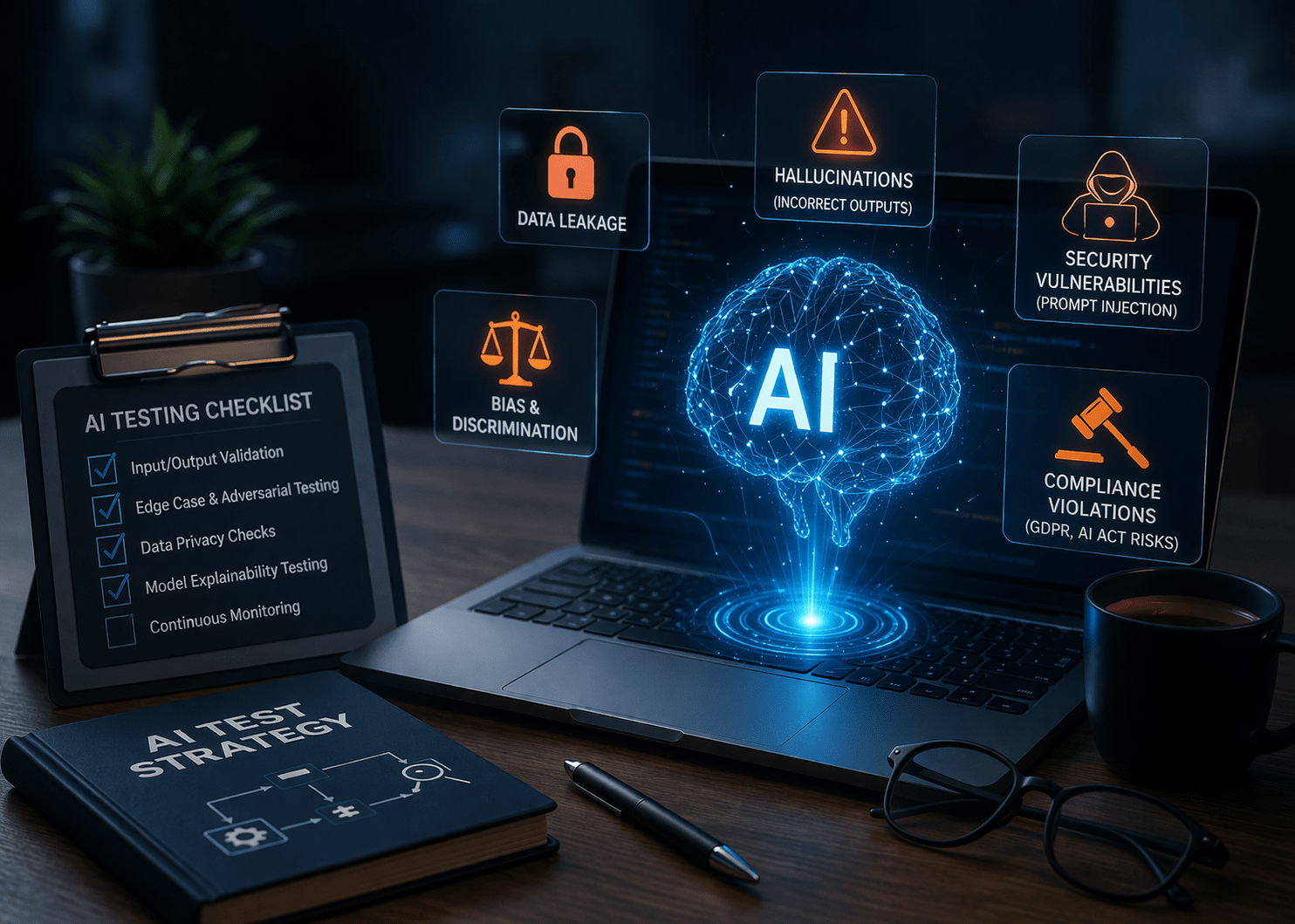
3.1. Data Leakage
AI models sometimes expose sensitive information without intention.
For example, a chatbot might reveal internal company data or user information if it has not been properly tested for data boundaries.
3.2. Bias and Unfair Decisions
AI learns from existing data. If that data contains bias, the AI can repeat or even amplify it.
This can result in:
- Unfair hiring decisions
- Biased recommendations
- Poor user experience for certain groups
3.3. Incorrect or Misleading Outputs (Hallucinations)
AI systems, especially generative AI, can produce responses that sound correct but are actually wrong.
For example:
A financial assistant providing incorrect tax advice can create serious consequences.
3.4. Security Risks
AI introduces new types of security threats, such as:
- Prompt injection attacks
- Manipulation of model behaviour
- Unauthorized access to sensitive data
3.5. Compliance and Legal Issues
With increasing regulations around AI and data privacy, companies must ensure:
- Proper handling of user data
- Transparency in decision-making
- Compliance with legal standards
Failure to do so can result in penalties and reputational damage.
4.Why Traditional Testing Is Not Enough
Most QA teams are used to testing:
- Functional behaviour
- User interfaces
- Performance
While these are important, they are not enough for AI systems.
AI requires testing that focuses on:
- Behaviour across different scenarios
- Output accuracy
- Risk identification
Traditional testing checks if the system works.
AI testing checks if the system behaves correctly in uncertain and real-world conditions.
5.What Effective AI Testing Should Include
To properly test AI systems, organisations need a broader approach.
5.1. Scenario-Based Testing
Testing AI across different real-world situations to see how it behaves.
5.2. Edge Case Testing
Checking how the system responds to unusual or unexpected inputs.
5.3. Data Privacy Validation
Ensuring that the AI does not expose sensitive or confidential data.
5.4. Bias and Fairness Testing
Validating that outputs are fair and do not favour or disadvantage specific groups.
5.5. Continuous Monitoring
AI systems should not be tested only before release. They need to be monitored continuously after deployment.
6.What Companies Often Miss
Many organisations make similar mistakes when implementing AI:
- Treating AI like traditional software
- Not investing in proper testing strategies
- Ignoring risks until issues occur in production
- Not monitoring AI after deployment
These gaps often lead to failures that could have been avoided.
7.How TestDel Can Help
At TestDel, we help organisations test and validate AI systems in a structured and practical way.
Our approach focuses on reducing risk while ensuring performance and reliability.
Our Capabilities Include:
- AI-focused testing strategies tailored to business needs
- Automation frameworks to support scalable testing
- CI/CD integration for continuous testing
- Testing across 250+ real devices
- Strong domain expertise in:
- Fintech
- Healthcare
- HR Tech
- ServiceNow
- Workday
- SAP
We provide a combination of:
- Manual testing
- Automation testing
- Security and risk validation
- Accessibility testing
Our goal is simple — help you launch AI features with confidence.
8.A Simple Real-World Example
Imagine a customer support chatbot that has not been properly tested.
- It gives incorrect answers to users
- It exposes internal information
- It behaves differently for similar queries
This can quickly lead to:
- Loss of customer trust
- Increased support costs
- Damage to brand reputation
Proper testing could have prevented all of this.
9.Conclusion
AI is a powerful tool, but it comes with new and complex risks. Unlike traditional software, AI cannot be tested using old methods alone. It requires a thoughtful, structured, and continuous testing approach.
Organisations that invest in proper AI testing will not only reduce risks but also build more reliable and trustworthy products.
If your organisation is building or planning to implement AI features, now is the right time to focus on testing.
? Connect with TestDel to:
- Identify potential AI risks early
- Build a strong testing strategy
- Ensure safe and reliable AI deployment
Let’s help you deliver AI with confidence.