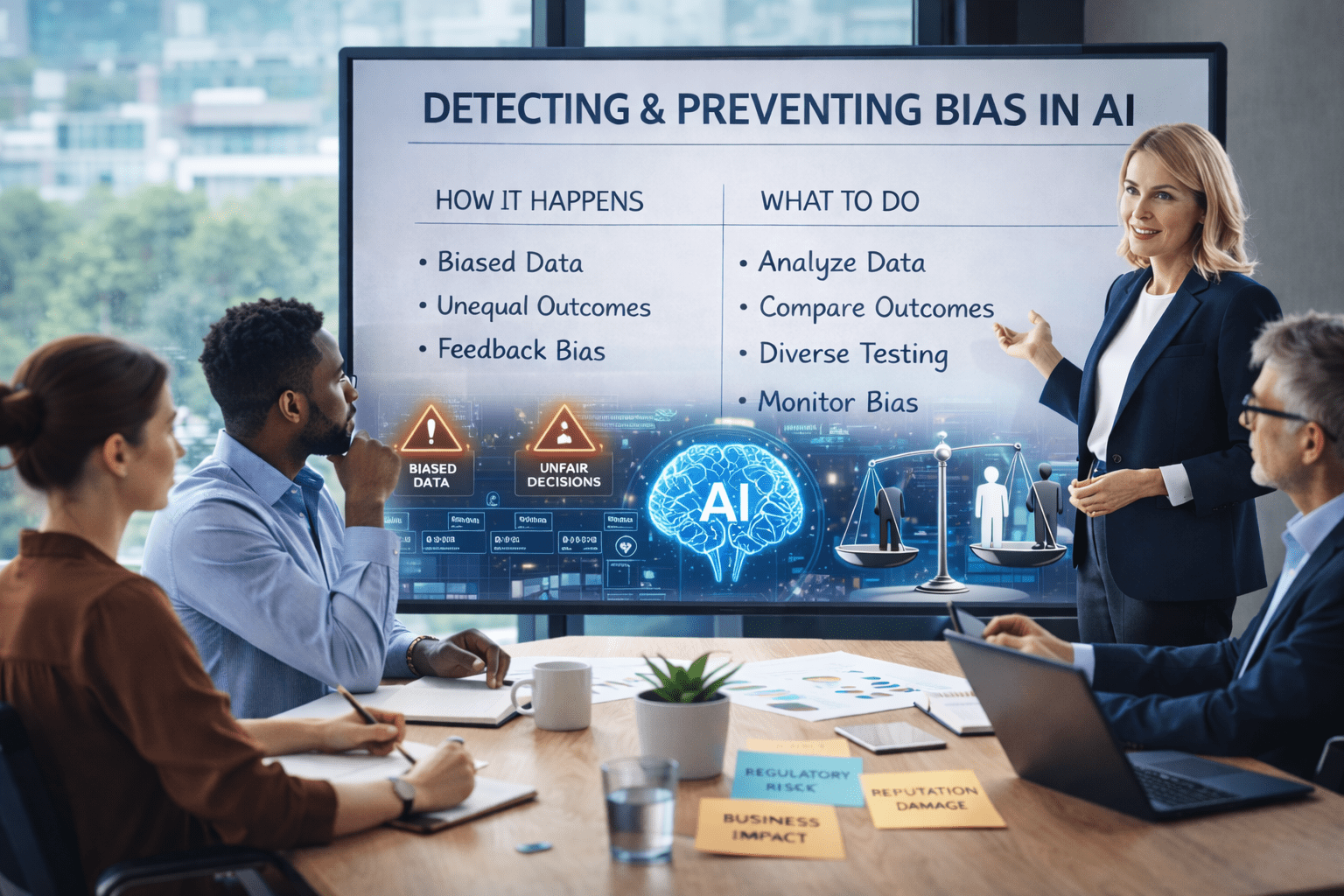
1. Introduction: The Risk You Don’t See Until It’s Too Late
AI systems are often evaluated based on accuracy, speed, and performance. If the model delivers correct outputs most of the time, it is considered successful.
But there is a critical question many organisations fail to ask:
Is the AI system fair for all users?
Bias in AI is not always obvious. Systems can perform well overall but still produce unequal outcomes for different groups of users. And unlike technical bugs, bias does not crash systems — it quietly affects decisions.
From hiring platforms and financial tools to healthcare systems, biased AI can lead to:
- Unfair decisions
- Regulatory violations
- Loss of trust
For CTOs, Product Managers, and QA leaders, addressing bias is no longer optional — it is essential.
2. Why Bias in AI Happens
AI systems learn from historical data. That data often contains patterns shaped by human decisions, and those decisions are not always neutral.
As a result, AI can inherit and amplify bias.
2.1 Key Sources of Bias
2.1.1. Biased Training Data
If the dataset:
- Overrepresents certain groups
- Underrepresents others
- Reflects past inequalities
The model will learn those patterns.
2.2.2. Imbalanced Data Distribution
Even without obvious bias, imbalance can lead to:
- Better performance for one group
- Poor accuracy for another
2.2.3. Feature Selection
Some features may indirectly introduce bias, such as:
- Location
- Education background
- Socioeconomic indicators
2.2.4. Feedback Loops
AI systems that continuously learn from user interactions can:
- Reinforce existing bias
- Drift further over time
3. Why Bias Matters More Than You Think
Bias in AI is often seen as a technical issue, but its impact goes far beyond engineering.
3.1. Regulatory and Compliance Risk
With increasing regulations around AI:
- Biased systems may violate legal standards
- Lack of fairness can lead to penalties
3.2. Reputation and Trust Impact
Users expect fairness.
If AI behaves unfairly:
- Trust is lost quickly
- Brand credibility is affected
3.3. Business Performance Impact
Bias can result in:
- Poor decision-making
- Missed opportunities
- Limited customer reach
In reality, bias affects both users and business outcomes.
4. How to Detect Bias in AI Systems
Detecting bias requires a structured and intentional approach. It cannot be identified through standard functional testing alone.
4.1. Dataset Analysis
Start by evaluating the data:
- Does it represent diverse user groups?
- Are certain categories underrepresented?
- Are there historical patterns that could introduce bias?
Many bias issues originate at the data level.
4.2. Output Comparison Across Groups
Test the model using the same scenarios across different user groups.
Look for:
- Variations in outcomes
- Differences in accuracy
- Patterns of favouritism or disadvantage
4.3. Scenario-Based Testing
Design test cases that reflect real-world diversity:
- Different demographics
- Edge cases
- Sensitive use cases
This helps uncover hidden biases in practical situations.
4.4. Fairness Metrics Evaluation
Move beyond accuracy.
Evaluate:
- Distribution of predictions
- Error rates across groups
- Consistency of outcomes
4.5. Continuous Monitoring
Bias is not static.
It can evolve due to:
- New data
- Model updates
- Changing user behaviour
Continuous monitoring is essential to detect emerging bias.
5. How to Prevent Bias in AI Systems
Detection alone is not enough. Prevention must be built into the system from the beginning.
5.1 Use Diverse and Representative Data
Ensure datasets:
- Cover all relevant user groups
- Avoid over-representation
- Reflect real-world diversity
5.2 Validate Fairness During Development
Do not wait until deployment.
Test for bias:
- During model training
- During validation
- Before release
5.3 Introduce Bias Testing Frameworks
Establish structured processes for:
- Testing fairness
- Evaluating outcomes
- Tracking bias metrics
5.4 Combine Automated and Manual Testing
Automation helps identify patterns at scale.
Manual testing helps interpret results and context.
Both are necessary for effective bias detection.
5.5 Monitor Post-Deployment Behaviour
After release:
- Track model outputs
- Analyse user interactions
- Identify anomalies
5.6 Regularly Update and Retrain Models
As data evolves, models should be:
- Updated
- Retested
- Revalidated
6. Real-World Example: When Bias Goes Unnoticed
Consider an AI-based hiring system.
It processes applications and recommends candidates.
Without proper testing:
- It may favour candidates from certain backgrounds
- It may filter out equally qualified individuals
- It may reinforce historical hiring patterns
The system works — but unfairly.
This can lead to:
- Legal challenges
- Loss of talent
- Reputational damage
7. What Companies Often Miss
Many organisations:
- Focus only on accuracy and performance
- Do not test across diverse scenarios
- Assume bias will be obvious
- Skip continuous monitoring
These gaps make bias harder to detect and easier to ignore.
8. How TestDel Helps You Build Fair and Responsible AI
Addressing bias in AI is not just about running tests — it requires understanding how decisions are being made and where risk can emerge over time.
At TestDel, we focus on helping organisations bring clarity and control into how their AI systems behave across different user groups.
8.1. Making Bias Visible (Before It Becomes a Problem)
One of the biggest challenges with bias is that it often goes unnoticed.
We help teams surface hidden bias by:
- Breaking down how different user segments are treated
- Identifying patterns that are not obvious at first glance
- Highlighting where outcomes begin to diverge
This allows organisations to move from assumptions to evidence-based validation.
8.2. Testing Beyond Accuracy
Most teams optimise for accuracy — but fairness requires a broader view.
We help shift the focus from:
- “Is the model correct?”
to - “Is the model consistent and fair across all users?”
This involves:
- Comparing outcomes across groups
- Evaluating how decisions differ under similar conditions
- Identifying edge cases where fairness breaks down
8.3. Designing Meaningful Test Scenarios
Bias cannot be detected with generic test cases.
We work closely with teams to design:
- Real-world user scenarios
- High-risk use cases (e.g., hiring, financial decisions)
- Situations where bias is most likely to appear
This ensures testing reflects actual usage, not just theoretical cases.
8.4. Helping Teams Build Long-Term Confidence
Bias is not something you “fix once.”
It changes with:
- New data
- Model updates
- Changing user behaviour
We support organisations in building processes that:
- Continuously evaluate fairness
- Detect drift early
- Maintain consistency over time
8.5. Working Alongside Your Teams
Rather than treating testing as a separate activity, we integrate closely with:
- Product teams
- Data science teams
- QA and engineering teams
This helps ensure fairness is considered at every stage — from development to deployment.
9. Conclusion: Fairness Is the Foundation of Trust
AI is increasingly influencing decisions that matter.
Bias in these systems can have serious consequences — for users, businesses, and society.
Organisations that prioritise fairness:
- Build trust with users
- Reduce regulatory risk
- Deliver better outcomes
As in AI, success is not just about performance, it is about fairness and responsibility.
If your organisation is developing or using AI systems, now is the time to address bias proactively.
Connect with TestDel to:
- Identify hidden bias in your AI systems
- Build a structured fairness testing strategy
- Ensure responsible and reliable AI deployment
Let’s help you build AI that works for everyone.