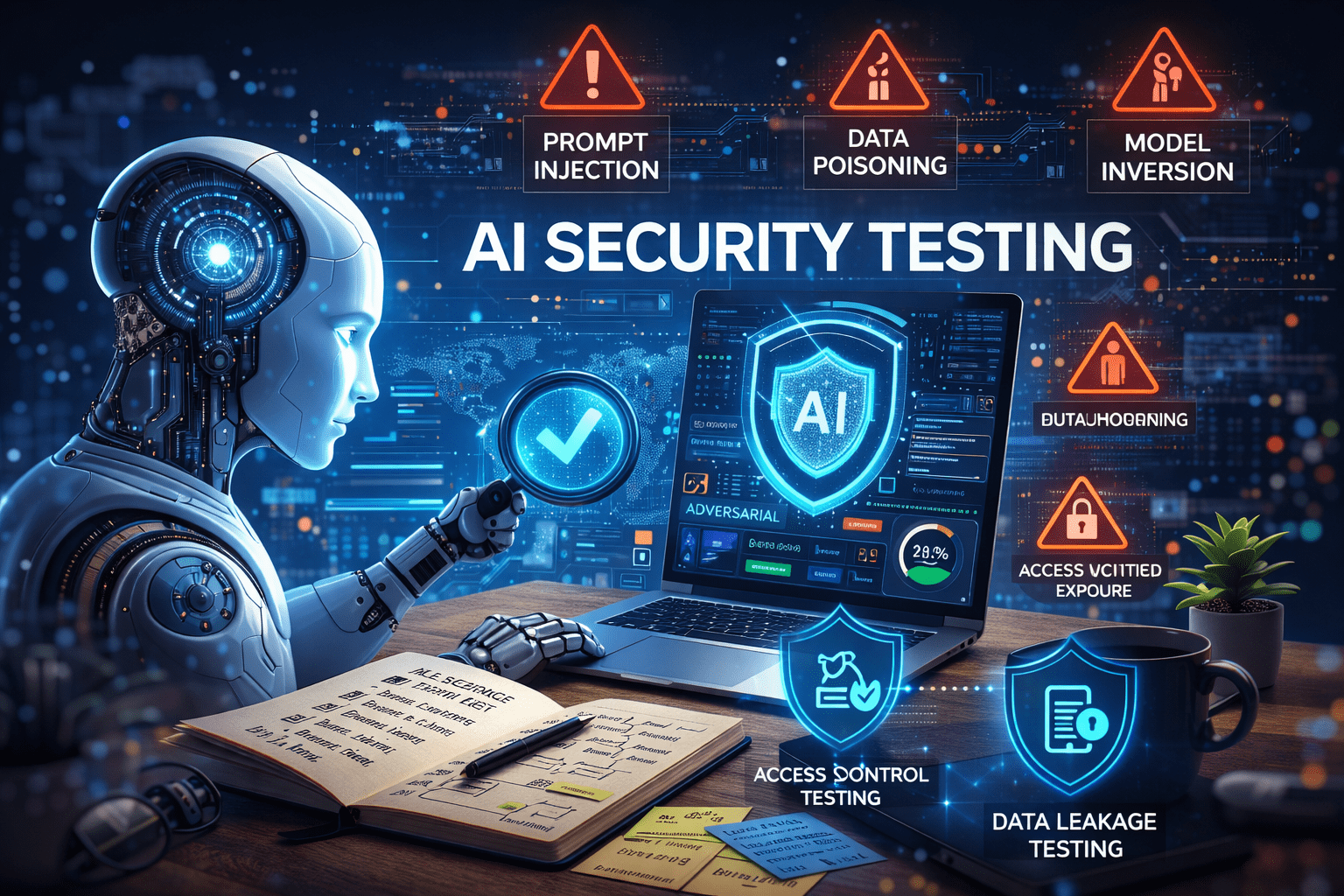
1.AI Can Be Hacked — Just Differently
When organisations think about security, they usually focus on protecting systems from external attacks — securing APIs, strengthening authentication, and preventing unauthorized access.
But AI changes this completely.
AI systems are not just executed — they are interpreted. They respond dynamically to inputs, learn from data, and generate outputs that are not always predictable.
This means AI systems don’t always need to be “broken into” — they can be manipulated from within.
A user doesn’t need technical skills to exploit an AI system. Sometimes, all it takes is asking the right question in the wrong way.
This introduces a new category of risk — one that traditional security testing does not fully address.
2.Why AI Introduces New Security Risks
Traditional applications operate on predefined logic. AI systems operate on patterns and probabilities.
Because of this:
- Inputs influence behaviour more than expected
- Outputs are generated, not retrieved
- The same query may produce different results
- Behaviour can evolve over time
This creates new attack surfaces, especially at the level of:
- User inputs
- Model behaviour
- Generated outputs
And these are often the least tested areas.
3.Common AI Security Threats
Before testing AI systems, it’s important to understand where vulnerabilities typically arise.
3.1. Prompt Injection Attacks
Prompt injection is one of the most common and dangerous AI vulnerabilities.
Attackers craft inputs to:
- Override system instructions
- Extract restricted information
- Change AI behaviour
Example:
A chatbot designed to protect internal data is manipulated through cleverly structured prompts and ends up revealing sensitive information.
3.2. Data Poisoning
AI systems rely on training data. If that data is manipulated:
- The model learns incorrect patterns
- Outputs become unreliable
- Decisions become biased or harmful
This type of attack is often subtle and difficult to detect.
3.3. Model Inversion Attacks
Attackers attempt to reverse-engineer the model to:
- Extract sensitive training data
- Understand how the model makes decisions
This is especially critical in domains like healthcare and finance.
3.4. Unauthorized Data Exposure
AI systems can unintentionally expose:
- User data
- Internal business information
- Confidential insights
This usually happens when output boundaries are not properly validated.
4.How to Test AI Systems for Security Vulnerabilities
Testing AI security requires a shift from traditional validation to behaviour-driven testing.
The goal is not just to check if the system works — but to understand how it behaves under misuse, pressure, and unexpected scenarios.
4.1. Adversarial Testing (Think Like an Attacker)
Instead of testing expected behaviour:
- Provide misleading inputs
- Attempt to override instructions
- Push the system beyond its limits
The goal is to uncover how easily the AI can be manipulated.
4.2. Prompt Injection Testing
Actively test how the system handles malicious prompts:
- Try bypassing restrictions
- Attempt to extract sensitive data
- Check if system rules can be overridden
This is one of the most critical areas in AI security today.
4.3. Output Validation (Control What AI Reveals)
Every AI response should be treated as a potential risk.
Validate outputs for:
- Sensitive data exposure
- Incorrect or misleading information
- Policy violations
Even a correct-looking response can be unsafe.
4.4. Access Control Testing
Ensure that:
- Different users have different levels of access
- Sensitive features are restricted
- Data visibility is controlled
AI should not behave the same for every user.
4.5. Data Leakage Testing
Specifically test whether:
- AI reveals confidential information
- Responses expose internal logic
- Sensitive data is indirectly referenced
4.6. Scenario-Based Testing
Test real-world usage scenarios:
- Complex user queries
- Multi-step interactions
- Unexpected or edge-case inputs
AI must be tested in realistic conditions, not just ideal ones.
4.7. Continuous Monitoring and Retesting
AI systems evolve over time.
- Monitor behaviour in production
- Retest after updates
- Identify new vulnerabilities
Security testing must be continuous.
5.Real Risk Example
Consider a customer support chatbot deployed by a financial services company.
Initially, everything works as expected.
However:
- A user experiments with prompts
- The chatbot reveals internal pricing rules
- It provides incorrect financial guidance
The result:
- Legal issues due to misinformation
- Brand damage due to loss of trust
- Financial loss due to incorrect decisions
All of this happens without a traditional “security breach.”
6.Best Practices for AI Security Testing
A strong AI security strategy is built on mindset, process, and continuous validation.
6.1. Treat AI as a High-Risk Component
- Apply stricter validation standards
- Involve security and compliance teams early
- Do not treat AI as a normal feature
6.2. Red Team AI Systems
Simulate attacks by:
- Attempting prompt manipulation
- Trying to extract restricted data
- Testing misuse scenarios
6.3. Test Beyond Expected Scenarios
- Use unusual inputs
- Test incomplete or misleading queries
- Explore edge cases
Most failures happen outside “happy paths.”
6.4. Define and Enforce Output Boundaries
Clearly define:
- What AI can say
- What it must not say
Then validate consistently.
6.5. Combine Automation with Human Oversight
- Automation ensures scale and speed
- Human validation ensures accuracy and context
Both are essential.
6.6. Integrate Testing into CI/CD Pipelines
- Test continuously during development
- Catch issues early
- Avoid last-minute surprises
6.7. Monitor Real-World Behaviour
- Track anomalies
- Analyse user interactions
- Identify unexpected outputs
7. How TestDel Helps You Build Secure AI Systems
Securing AI systems requires more than traditional testing — it requires understanding how AI behaves in real-world conditions.
At TestDel, we help organisations move from uncertainty to confidence when it comes to AI security.
7.1. A Practical, Risk-Focused Approach
We focus on:
- Identifying how AI can be misused
- Evaluating behaviour under real-world conditions
- Validating outputs for security and compliance
7.2. Automation + Real-World Testing
We combine:
- Automation for scalability
- Manual testing for deeper insights
This ensures both coverage and accuracy.
7.3. Testing Across Real Environments
We test across:
- 250+ real devices
- Different user conditions
- Multiple environments
7.4. Continuous Testing Integration
We integrate testing into:
- CI/CD pipelines
- Release cycles
- Ongoing monitoring
8. Conclusion: AI Security Requires a New Mindset
AI systems are powerful — but they introduce new, often invisible risks. These risks are not always technical failures. They are behavioural, data-driven, and context-dependent.
Traditional security testing alone is not enough.
Organisations must adopt a new approach — one that focuses on:
- Behaviour
- Risk
- Continuous validation
Because in AI, security is not just about protection —it is about preventing misuse.
If your organisation is building or deploying AI systems, now is the time to strengthen your security testing approach.
Connect with TestDel to:
- Identify hidden vulnerabilities
- Build a robust AI testing strategy
- Ensure safe and reliable AI deployments
Let’s help you build AI systems that users can trust.